

Business transfer: Anticipate to preserve

The transfer of a business is far more than a simple financial operation. It is a strategic stage where the sustainability of jobs, the continuity of know-how, the resilience of the local entrepreneurial fabric, and the safeguarding of the owner’s assets are at stake. How can one preserve value, anticipate challenges, and seize opportunities?*
In France, the figures tell a paradoxical story. Company creations have quadrupled since the early 2000s, but transfers have long declined. In 2012, there were 75,000 transfers, compared to only 38,000 in 2020. It was only in 2023 that the trend reversed, with 51,000 transfers. Yet two out of three companies remain threatened with disappearance, due to a lack of anticipation and knowledge of the transfer process. In Luxembourg, although figures are harder to obtain, there is no reason to believe the reality is fundamentally different.
What should be done in the face of such a finding? Emphasize the importance of proper preparation and propose a few key elements to consider in order to transform the transfer process into an opportunity, both for the owner and for the sustainability of the company’s activities.
It is a moment where economic logic and the emotion of passing the torch intertwine.
Business transfer: A choice between reason and passion
What motivates business leaders who wish to transfer their companies? Motivations may be personal, strategic, or economic. Retirement is of course the primary reason, but it does not explain everything. Some entrepreneurs want to turn the page to dedicate themselves to new projects, others seek to attach their company to a stronger group, or to seize a market opportunity before it vanishes. Some lack an internal successor or simply wish to revitalize the company.
There are also more personal reasons: fatigue, health, the desire for a fresh start, or the need to diversify both assets and patrimonial risks. Transfer then becomes a way to reinvent one’s life while ensuring the continuity of what has been built, sometimes over several decades. It is a moment where economic logic and the emotion of passing the torch intertwine.
Anticipation for success
A successful transfer cannot be improvised. It is sometimes prepared several years in advance and begins with clarity about what is to be transmitted and in what form. Depending on motivations, the owner must clarify objectives: prioritize price, continuity, a family or external takeover? He must also reduce the company’s dependence on himself, by gradually delegating, retaining talent (profit-sharing or stock options), and securing relationships with clients and suppliers.
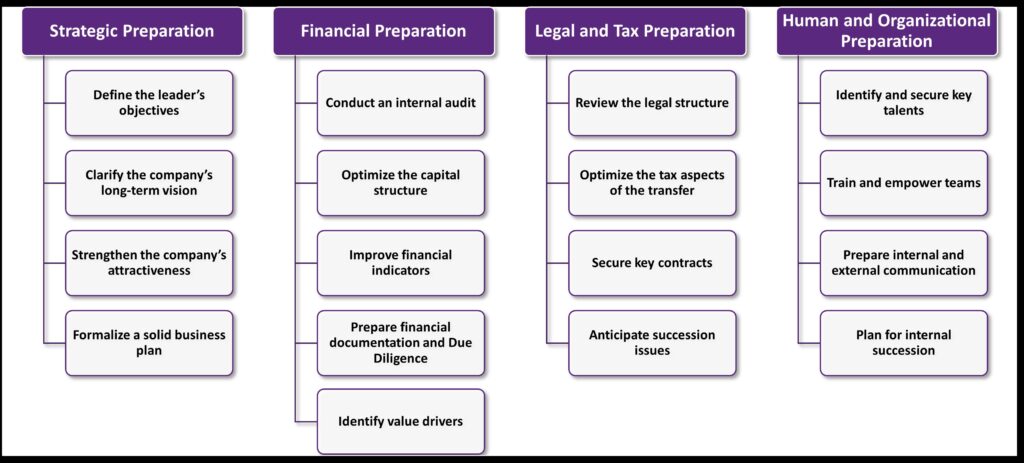
Transfer is therefore a global process, touching strategy, finance, law, and organization.
On the financial side, a rigorous audit is indispensable: cleaning up accounts, rationalizing debt, mastering working capital requirements. On the legal and fiscal side, it means simplifying the structure, anticipating succession issues, securing key contracts. Finally, on the human side, teams must be prepared, communication established, and trust built.
Transfer is therefore a global process, touching strategy, finance, law, and organization. It requires time, method, and a clear vision.
Source: BIL Corporate Finance
Business transfer requires professional support at every stage of the process. The investment banker plays a central role in helping maximize the company’s value and securing its sustainability.
The investment banker: A discreet conductor
Each stage of transfer potentially mobilizes multiple and varied expertise. In this complex ballet, the investment banker plays a central role. He is not merely an intermediary and negotiator between seller and buyer; he is truly the conductor of the transaction, helping to:
-
- clarify priorities (price, solid buyer, timetable);
- realistically value the company (teaser, memorandum, business plan);
- identify the right buyers (industrial groups, funds, foreign actors);
- optimize deal conditions (price, clauses, guarantees) while preserving team serenity;
- secure the process (coordination with lawyers, tax advisors, experts).
In short, the investment banker is the architect of the transaction, guarantor of value, and defender of the seller’s interests.
Transmission is not one-size-fits-all
Not all transfers are alike, and it is important to understand that there are several possible paths and many types of buyers. Transfer may take the form of a total or partial sale to a third party, whether an industrial group or an investment fund. There is of course family transfer, reassuring in its continuity but often requiring training, financing, and possibly capital restructuring. There is also the MBO (Management Buyout) or LBO (Leveraged Buyout), where the management team takes the reins, often with leverage. This formula reassures stakeholders but generally requires financing or an external investor. Finally, there is takeover by a group, which implies heavier structuring and often impacts governance.
Each model has its advantages and constraints. The choice depends on the owner’s profile, the company’s maturity, and the buyer’s ambitions. Here again, it is important to rely on experts capable of guiding you toward the most suitable solution.
From transfer to transition
Finally, support must not be neglected. Transfer is not a guillotine, but a gradual passage. The owner must define a clear timetable, train his successor, involve key managers, reassure teams and secure talent, clarify any post-sale role. He must also maintain external relationships (clients, suppliers, financial partners) and establish a climate of trust with buyers.
A gradual exit, over several months or years, helps limit shocks and ensure smooth continuity. This is where transfer truly becomes an act of trust and sustainability.
Business transfer is a moment of truth. Well prepared, it becomes a tremendous opportunity for growth, patrimonial security, and economic continuity. Transferring one’s company means writing a new chapter where strategy and emotion meet to build the future.
* Content translated from French by the BIL GPT AI tool
 Mortgage
 Personal loan
 Savings